Sonnet AI
Transforms meeting recordings into structured notes, summaries, and action items automatically.
Are you the owner?
Claim this tool to publish updates, news and respond to users.
Sign in to claim ownership
Sign InDescription
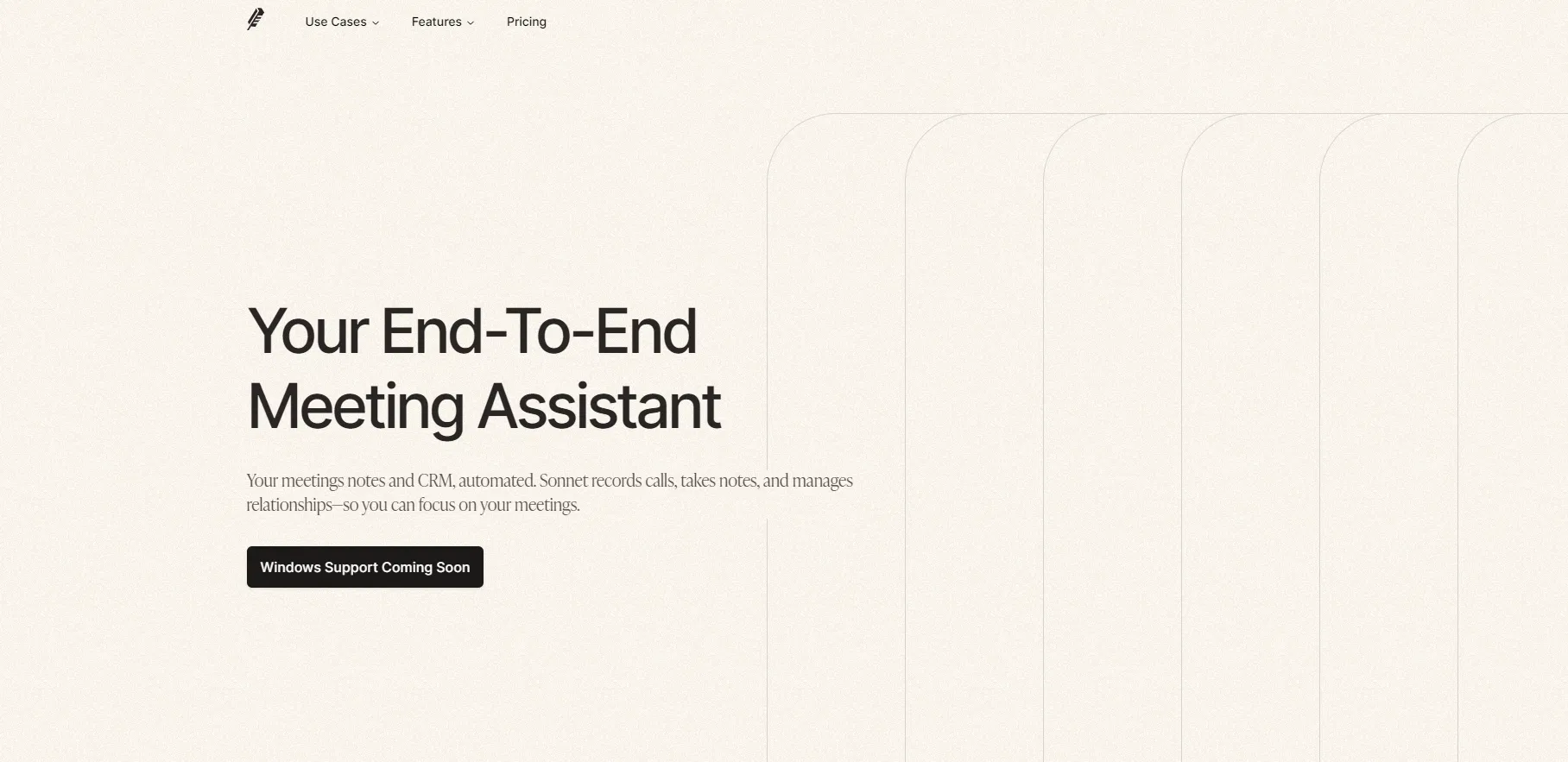
Sonnet AI is an intelligent meeting assistant designed to capture and distill the essence of conversations, created by a team focused on productivity enhancement. Its core value lies in eliminating the manual burden of note-taking, allowing participants to be fully present and engaged during discussions while ensuring no critical detail or action item is lost. By processing audio in real-time or from recordings, it delivers immediate, accurate, and shareable documentation, fundamentally changing how teams manage and leverage their meeting outcomes.
Key features include automatic transcription with speaker identification, generating concise summaries that highlight key decisions and discussion points, and extracting specific action items with assigned owners and deadlines. The tool also creates searchable transcripts, enables users to highlight important moments, and can integrate these outputs directly into project management or collaboration platforms. This transforms raw dialogue into organized, actionable intelligence that drives projects forward.
What sets Sonnet AI apart is its deep contextual understanding, which goes beyond simple transcription to grasp intent, decisions, and commitments within the flow of conversation. It employs advanced natural language processing models fine-tuned for business discourse. The platform is accessible via web application and offers integrations with popular calendar, video conferencing, and productivity tools like Google Meet, Zoom, Microsoft Teams, Slack, and Notion, creating a seamless workflow from meeting to execution.
Ideal for remote and hybrid teams, project managers, sales professionals, and consultants who conduct numerous client or internal meetings. Specific use cases include capturing requirements from client discovery calls, ensuring accountability in project syncs by tracking action items, distilling insights from brainstorming sessions, and creating accessible archives of training or onboarding meetings for future reference, thereby saving hours of manual work and improving organizational clarity.